A Badge Is Not a Team’s Whole Story
A club badge can mean different things to different viewers. Learn how to read its symbols without mistaking one personal association for the whole story.
What does a club badge mean if the same crest feels welcoming to one supporter and alienating to another? A club badge can carry several meanings at once: a club’s intended identity, a fan’s memories, a rival’s associations, or simply a shape someone recognizes from a shirt. The emblem gives you clues, but it cannot tell the whole story on its own.
That distinction is useful whenever you are looking at a team you do not know well. Rather than asking for the single correct interpretation, start with your situation: are you trying to identify the club, understand its visual choices, or make sense of a personal reaction? Each calls for a different kind of reading.
If you need to identify the team, treat the badge as a clue
A crest is often designed to be recognizable at a glance. Its outline, colors, initials, animal, plant, landmark, or object may help distinguish one club from another, especially when names are unfamiliar. But recognition is not the same as understanding. A crown might be a local reference, a traditional motif, or simply part of a design inherited from an earlier badge.
Look at the whole arrangement before assigning meaning to one detail. Notice which elements are largest, where the name sits, and whether a date, place, or initials appear. A word or location can anchor an otherwise ambiguous image. If the badge appears on a kit, program, or stadium sign, its context may help you connect the emblem to the club without asking the symbol to explain everything by itself.
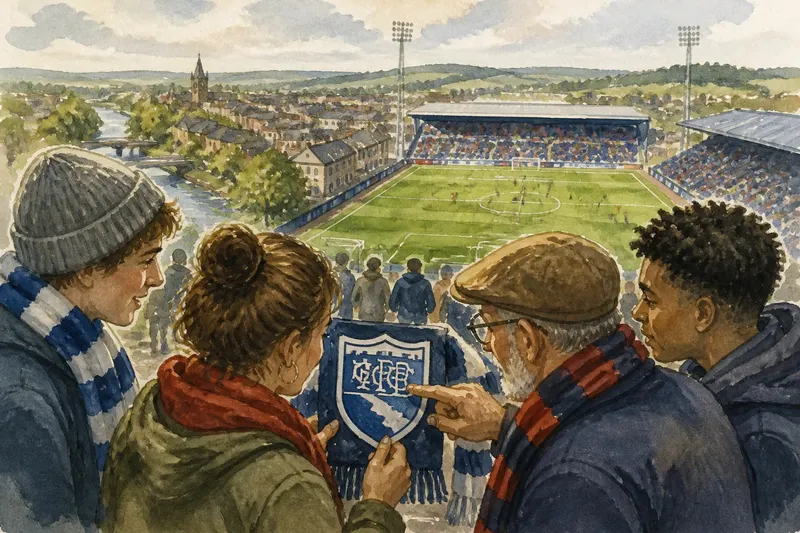
Say you see a shield with a river shape and a set of initials on a team scarf. You can reasonably treat the initials as a useful identification clue and the river as a possible local reference, but the drawing alone does not establish why the club chose it. The observable result is a more careful identification: you can describe what is visible while leaving its deeper story open.
If you are curious about the club’s intended meaning, seek its own explanation
When the question is what the club intended its badge to communicate, look for information from the club itself: an official crest description, a history page, a museum display, or material accompanying a redesign. That is the best place to learn whether a feature refers to a neighborhood, a founding group, an industry, a landscape, or a club tradition.
Keep the wording precise. “The club says the bird refers to the city’s emblem” is different from “the bird means courage.” The first reports an attributed explanation; the second can turn a broad visual association into a fact the design may not support. If the club offers no explanation, describe the image and its placement rather than filling the gap with a confident story.
Official explanations have a particular scope: they tell you how the organization presents its choices. They do not settle every association viewers bring to the badge. A club may intend a symbol as a nod to local history while a supporter connects it to a family memory, or an opponent sees it through a rivalry. Those readings can coexist without being interchangeable.
If you are a supporter, your memories belong in the reading
For a supporter, a badge may stand for much more than its printed components. It might call up a first match, a relative’s old scarf, a long trip to an away game, or the feeling of finding familiar colors in a crowd. Those associations are real parts of that person’s relationship with the club, even if they are not encoded in the emblem’s official design notes.
This is why a badge can feel personal without having one universal meaning. Two people who have followed the same club for years may connect its crest to different moments. Someone new to the sport may see only a graphic; a local supporter may recognize a place name or a detail tied to neighborhood life. Neither response has to displace the other.
If you are describing your own reaction, make it yours: “I associate this crest with the old scarf my uncle wore,” rather than “this crest means family.” The first is specific and generous. It lets another supporter offer a different memory without turning the conversation into a contest over who owns the symbol’s meaning.
If you are a rival or a visitor, separate your reaction from the club’s message
Rivalries give symbols an extra layer. A badge may prompt a quick reaction because of a tense match, a familiar chant, or a repeated image in local sports coverage. That response tells you something about your own relationship to the club and its rivals; it does not automatically explain what the emblem means to the club or its supporters.
Visitors can be in a similar position. A motif that looks familiar may carry a local reference you do not know, while an apparently decorative flourish may be highly recognizable to people who see the crest every week. You can ask a supporter what a detail means to them, while leaving room for the answer to be personal rather than official.
When discussing an emblem in a mixed group, use language that keeps those viewpoints distinct. “I recognize that symbol from our rivalry” describes your association. “The club uses it to represent its district,” if that is the club’s stated explanation, describes an attributed intention. This small distinction helps people disagree about a badge without treating one person’s reaction as a universal fact.
If you are analyzing the design, describe what you can see first
A design reading begins with observable choices: shape, line, color, lettering, scale, and the way elements overlap. Is the badge round or shield-shaped? Is the name prominent, or does an image take center stage? Does a border separate the elements, or do they run together? These details let you explain how the emblem is organized before interpreting what it might suggest.
Then distinguish visual effect from documented meaning. A sharp-edged animal may look energetic to one viewer and aggressive to another; the shape supports those impressions, but neither is automatically the club’s intention. A ring around a crest may create a contained, traditional feel, but that reading is still a response to form unless the club explains it otherwise.
It can also help to compare versions of the same badge, if the club has shared them. A simplified mark used on a digital score graphic may omit details found on a full crest. That does not necessarily change the symbol’s meaning; it may reflect a different display context. Describe what changed before claiming what the change says about the club.
Which way of reading a badge fits your situation?
How can I tell what a symbol on a badge represents?
Start with the club’s own description or other official material, then separate that explanation from your visual impression. If no explanation is available, identify the visible feature and call its meaning uncertain rather than assigning it a fixed story.
Can one badge mean different things to different supporters?
Yes. The club’s intended message, a supporter’s memories, and a rival’s associations can all attach to the same emblem. Those meanings describe different relationships to the badge, not necessarily competing claims about one hidden answer.
Does a badge’s design tell me what kind of club it is?
It can suggest an identity through its name, imagery, colors, or local references, but a visual suggestion is not a complete account of the club. Use the badge to form a question, then look to the club’s words and actions for a fuller picture.
What should I say if I am unsure what an emblem means?
Describe what you see and ask how the club or its supporters explain it. Phrases such as “this looks like a river” or “I associate this shape with the neighborhood” make room for correction and for more than one response.
A careful reading keeps the badge open to conversation
The most useful way to read a club badge is to match your claim to your position. If you need to identify a team, use visible details as clues. If you want its intended explanation, look for the club’s account. If the emblem brings back a match or a family story, name that as your association. And if you are analyzing the design, describe its features before deciding what they communicate.
A badge can be a public mark and a private memory at the same time. Read its shapes closely, but leave enough room for the people who wear it, support it, or oppose it to bring their own context. That is not a failure to interpret the emblem; it is a more accurate account of how symbols work.