The White Lines That Make a Tennis Court Legible
Tennis court markings show where rallies, serves, and doubles play belong, helping you follow the action and understand which line sets each boundary.
Which white line tells you where a tennis ball belongs? On a tennis court, the answer depends on the shot: the outer lines define the playing area, while the service lines divide it into target boxes. Read those markings as a simple map, and the rally becomes easier to follow from the baseline to the net.
What do the tennis court lines mark?
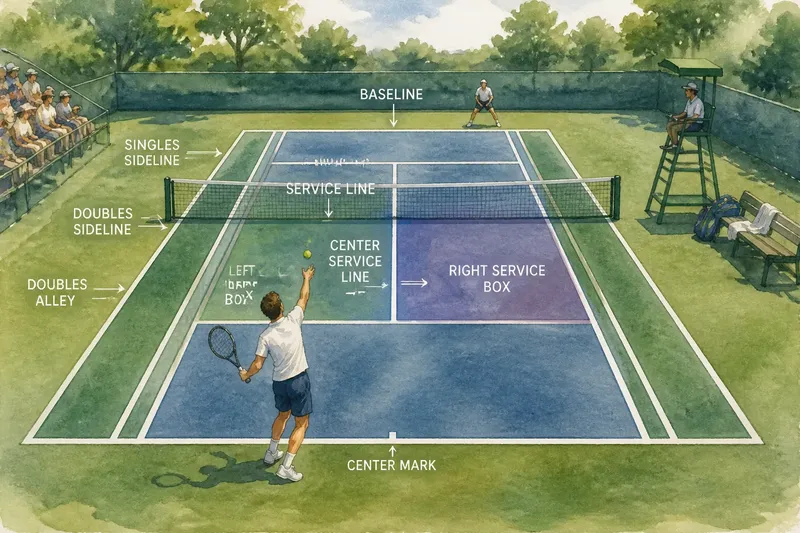
The lines carve the court into zones with different jobs. The baselines close off each end, the sidelines set the court’s width, and the center service line splits the service area into left and right boxes. The net separates the two sides of play.
Some lines matter only in certain formats. In singles, the inner sidelines bound the playing area; in doubles, the wider outer sidelines count too. The doubles alleys are the strips between those pairs of sidelines. They add width to rallies but do not enlarge the service boxes.
This means a court is not a collection of interchangeable stripes. A ball can be in for a doubles rally and out for a singles rally, even when it lands in the same alley. For a serve, the receiver’s service box—not the full doubles width—sets the target.
Which lines decide whether a shot is in?
A ball that touches a boundary line is in, because the line belongs to the area it marks. For a singles rally, judge the ball against the singles sidelines and baselines; for doubles, use the outer sidelines and baselines. The net is a divider, not a boundary at the end of the court.
Where a ball lands matters. A shot that bounces beyond the relevant baseline or sideline is out, while a ball that clips the line remains in. Players and spectators may see a close call differently from the far side of the court, so watching the bounce—not where the ball travels afterward—helps make the ruling clearer.
How do the service lines divide the court?
The service line runs parallel to the net on each side. Together with the net, singles sidelines, and center service line, it outlines four service boxes: two on each side of the net. The server aims diagonally into the box opposite their position.
The center mark at each baseline helps identify the server’s starting position. A player serves from behind the baseline, alternating between the right and left halves as points progress. That change of side is why a legal service target switches between the receiver’s two boxes.
Once the serve lands and the rally begins, the service boxes stop defining the playable area. The ball may land anywhere inside the boundaries for the current format. The service line is therefore a target boundary for the serve, not a back wall for the rally.
Why are there different sidelines for singles and doubles?
The inner sidelines show the narrower singles court, and the outer sidelines show the wider doubles court. The space between them is the doubles alley. This arrangement lets one surface support both formats without changing the net or repainting the court.
Imagine a beginner watching a doubles match and seeing a ball land in the alley. The ball is inside the doubles boundary, so play continues; if the same spot were used in singles, it would be outside the singles sideline. Checking which format is underway is the quickest way to read that bounce.
During doubles serves, the alleys still do not count as service targets. A serve must land in the diagonally opposite service box. After the return, the wider doubles boundaries apply to the rally.
How can you tell which marking matters during a point?
Start with the phase of play, then identify the format. On a serve, follow the diagonal service box; after the ball is returned, follow the appropriate singles or doubles sidelines. At the baseline, use the baseline to judge how deep the ball lands.
- Before the serve: Find the center mark and note which side the server occupies.
- As the serve crosses the net: Track the opposite service box, not the doubles alley.
- After the return: Use the singles sidelines or the wider doubles sidelines, depending on the match.
- At the back of the court: Watch whether the bounce touches the baseline or lands beyond it.
- For a close call: Focus on the first bounce against the relevant line, rather than the ball’s path after it lands.
This quick sequence also helps spectators follow why a serve can be out while a later shot into the same general area is playable. The court’s zones change purpose with the phase of the point.
What do beginners often misunderstand about court markings?
Does the line count as in?
Yes. If the ball touches the boundary line that applies to the shot, it is in. A bounce fully beyond that line is out.
Do doubles alleys count on a serve?
No. The serve must land in the correct diagonal service box, which is bounded by the singles sideline. The alleys become part of the playable width after the serve is returned.
Does the service line matter after the serve?
It helps define the service box, but it does not limit ordinary rally shots. After the return, a ball may land between the service line and baseline and remain in play if it is within the correct sidelines.
Why does a ball near a line seem hard to judge?
The view from the opposite end can make a bounce look closer to or farther from a line than it is. Keep your attention on the landing point and the boundary for that format; avoid judging by where the ball ends up after its bounce.
Why do court markings make tennis easier to watch?
Lines turn movement into readable territory. The baseline signals depth, the sidelines signal width, and the service markings show the server’s immediate target. Once you know which boundaries apply, you can tell whether a player is defending the back of the court, opening an angle, or trying to place a serve into a specific box.
The white lines are most useful when treated as a working map rather than decoration. Keep the format and phase of play in mind, and tennis court markings will explain not only whether a ball is in, but which part of the court the players are trying to control.