How to Read an Unfamiliar Sports Venue at a Glance
Read an unfamiliar sports venue at a glance by matching signs, color zones, and repeated shapes to your destination, so you can move with less guesswork.
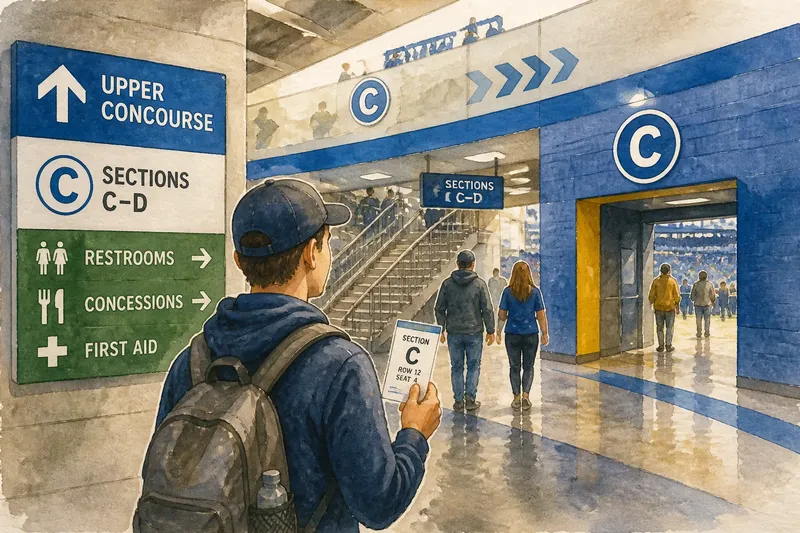
Where should you look first when you enter an unfamiliar sports venue? To read an unfamiliar sports venue at a glance, start with signs that point to your destination, then use colors and repeated shapes as supporting landmarks. This quick scan helps you tell nearby routes and areas apart without treating decoration as directions.
Start with signs that answer immediate questions
At the entrance, look for signs that help with your next decision: where to go, which areas you may enter, and where seating sections begin. A large directional arrow is more useful at this moment than a sponsor panel or decorative mural. Follow the information you need now; save the rest for later.
Notice how signs are grouped. A board might pair a section name with an arrow, while a smaller sign nearby lists amenities. The larger label directs movement, and the nearby details refine the destination. If you are meeting someone, match the section label on your ticket to the venue sign rather than relying on color alone.
Signs can also distinguish spaces with different access rules. A doorway marked for staff, players, or media is not simply another route through the building. Stay in public areas unless your ticket or an event official directs you elsewhere. For accessibility needs or a route that is hard to interpret, ask venue staff instead of guessing.
Use color zones as broad landmarks
Color often helps divide a large venue into memorable areas. You might see one hue repeated on a concourse wall, a seating section marker, and a wayfinding panel. Treat that repetition as a broad landmark rather than a precise map: color can help you remember an area, but section letters and numbers identify a specific destination.
Notice where a color begins and ends. A change near a stairwell, doorway, or corridor junction may signal a transition between zones. This can help in long stretches of similar-looking walls or seats. Look for written labels alongside the color, since lighting, distance, and crowd movement can make a hue harder to distinguish.
Color zones do not always correspond to teams or seating categories. A venue may use a bright color for an entrance route, a muted one for a general concourse, or several colors for different levels. Read words and arrows first, then use color as an additional cue.
Use repeated shapes to recognize signs and routes
Look for a shape that appears in more than one place: a chevron on signs, a circle around a section number, or angled panels along a corridor. Repetition may signal a shared visual style. Once you recognize a shape, you can spot related signs without studying every panel from scratch.
Keep the meaning modest. A repeated triangle may be decorative rather than directional. Check whether it appears alongside an arrow, a label, or a consistent route marker before treating it as information. Ask what job the shape seems to do in this venue rather than assuming it has a universal meaning.
Shape can also help distinguish similar signs. A rounded panel might mark facilities, while rectangular boards carry section names. That is not a universal code, but consistent placement and styling within one building can make the next sign easier to recognize.
Follow one reliable cue to your destination
After your first scan, choose one detail to follow: a section letter, a route color, a distinctive arrow, or a recognizable entrance sign. Tracking one cue keeps banners, screens, railings, and seat backs from becoming a jumble.
Say you enter a fictional indoor arena with a ticket for Section C. You notice an arrow for the upper concourse, a blue band repeated near several stairways, and circles around section letters. You follow the arrow, use the blue band only as a broad landmark, and look for the circled C at the seating entrance. The resulting choice is to enter when the written section label matches your ticket, rather than treating the blue band as proof that you have arrived.
How can you read venue cues without guessing?
What should I notice first in an unfamiliar sports venue?
Start with a directional sign and the label for your destination, then note nearby colors and repeated shapes. This gives you an immediate route while leaving decorative details for a calmer moment.
Can I use color alone to find my section?
Use color as a landmark, not as the final identifier. Confirm the section with its letter or number, because venue colors may mark entrances, levels, or general zones rather than individual seating areas.
What if the signs and colors seem to conflict?
Pause in a safe spot that is clear of the flow of people and check the written direction to your destination. If the route remains uncertain, ask an usher or other venue staff member rather than entering a restricted area.
How do I tell a directional shape from decoration?
Look for the shape beside an arrow, a destination label, or other signs placed along the same route. If it appears only as a pattern, treat it as decoration until a clear direction confirms its purpose.
Keep the first scan focused on finding your way
You do not need to decode every graphic in the building. Match your destination to written signs, use colors to remember broad areas, and treat recurring shapes as clues only when labels and placement support them. That is a practical way to read an unfamiliar sports venue at a glance while keeping your route clear and your attention on where you are headed.